Internet Shutdown Statistics 2026
목차
- Key figures at a glance
- Shutdowns keep climbing, and 2025 set a record
- Who shuts down the internet the most
- One region accounts for half the world's shutdowns
- What triggers a shutdown
- From whole networks to single apps
- What shutdowns cost the world
- What shutdowns look like in VPN install data
- Spotlight: Russia became the costliest shutdown regime in the world
- Methodology
- Sources
Let's talk about how often governments switch the internet off, where, why and what it costs, based on Access Now's #KeepItOn data and Top10VPN's economic estimates.
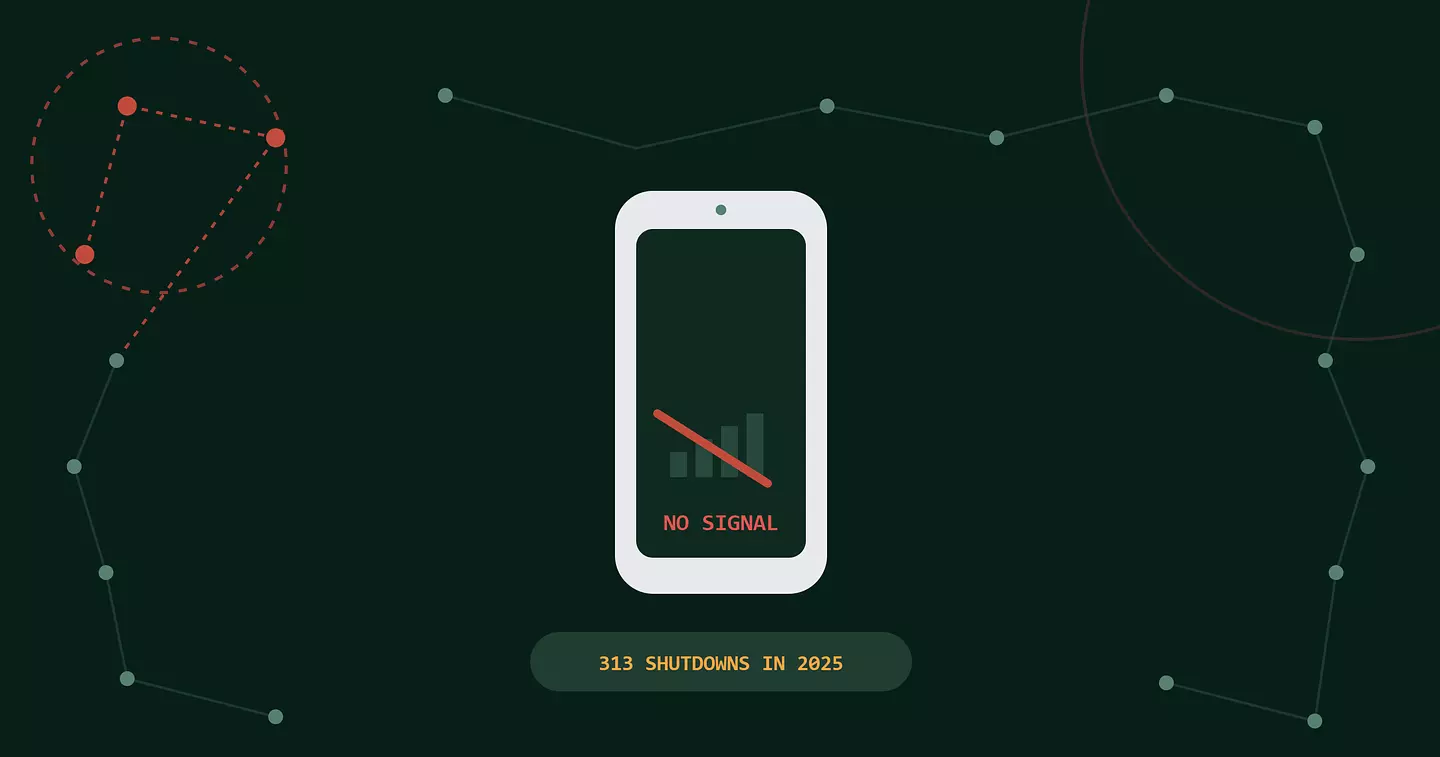
Government-imposed internet shutdowns hit a new record in 2025, with 313 recorded across 52 countries. The economic toll rose sharply too, reaching $19.7 billion in damage, a 156% increase over the previous year.
Key figures at a glance
Shutdowns keep climbing, and 2025 set a record
Shutdown counts keep climbing: 289 in 2023, 304 in 2024, and a record 313 in 2025.
Economic damage follows a rockier path: Russia's social media bans drove a $24.6 billion spike in 2022 that has not been matched since, though 2025's $19.7 billion (up 156% on 2024, again driven largely by Russia) came close.
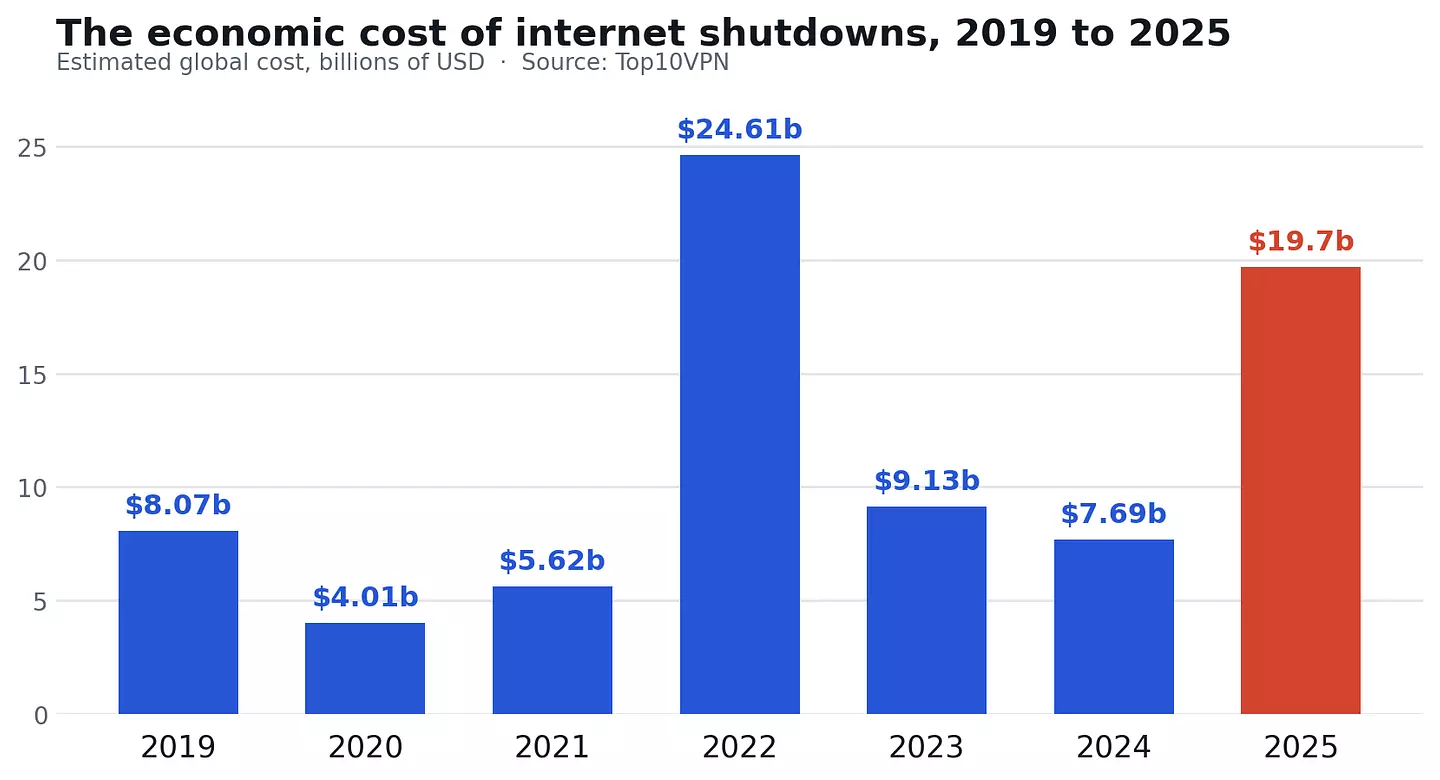
Estimated global economic cost, billions of USD. Source: Top10VPN.
Sources: Access Now / #KeepItOn 2025; Top10VPN 2025.
Who shuts down the internet the most
Myanmar led for the second year running with 95 shutdowns, most imposed by the military. India followed with 65, its lowest since 2017 but still the most of any democracy.
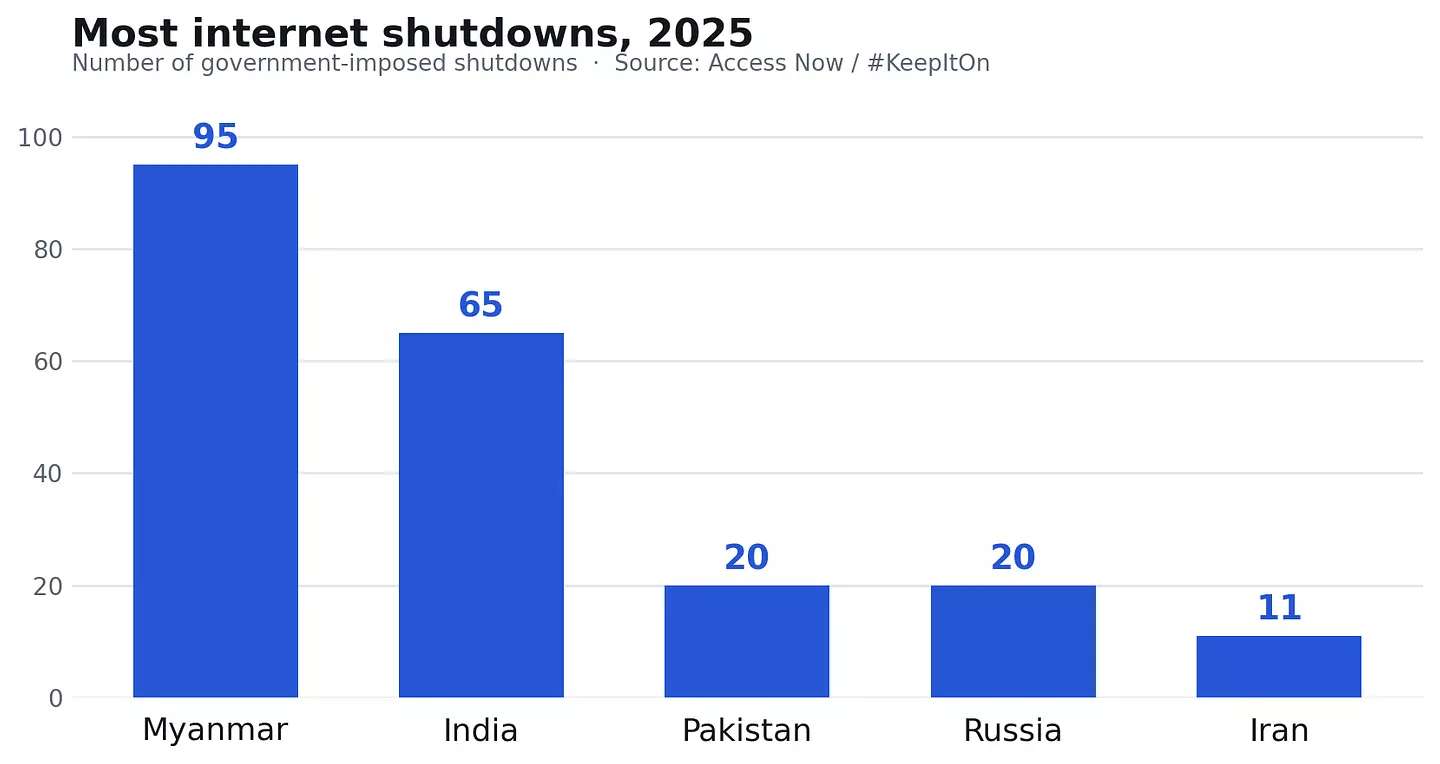
Country | 2025 shutdowns | Economic cost |
|---|---|---|
Myanmar | 95 | $1.89B |
India | 65 | n/a |
Pakistan | 20 | n/a |
Russia | 20 | $11.9B |
Iran | 11 | n/a |
Tanzania | 8 | n/a |
Venezuela | n/a | $1.91B |
Keep in mind: shutdown counts are from Access Now; cost figures are from Top10VPN, which uses a different methodology, so the two columns are not directly comparable.
One region accounts for half the world's shutdowns
The Asia-Pacific alone was responsible for around half of all shutdowns in 2025, and for roughly three quarters of conflict-related ones. The Middle East and North Africa and sub-Saharan Africa followed, with election-day blackouts a recurring feature across Africa.
Region | Shutdowns | Countries |
|---|---|---|
Asia-Pacific | 195 | 11 |
Middle East & North Africa | 52 | 15 |
Africa (sub-Saharan) | 30 | 15 |
Latin America & Caribbean | 5 | 2 |
Source: Access Now / #KeepItOn 2025.
What triggers a shutdown
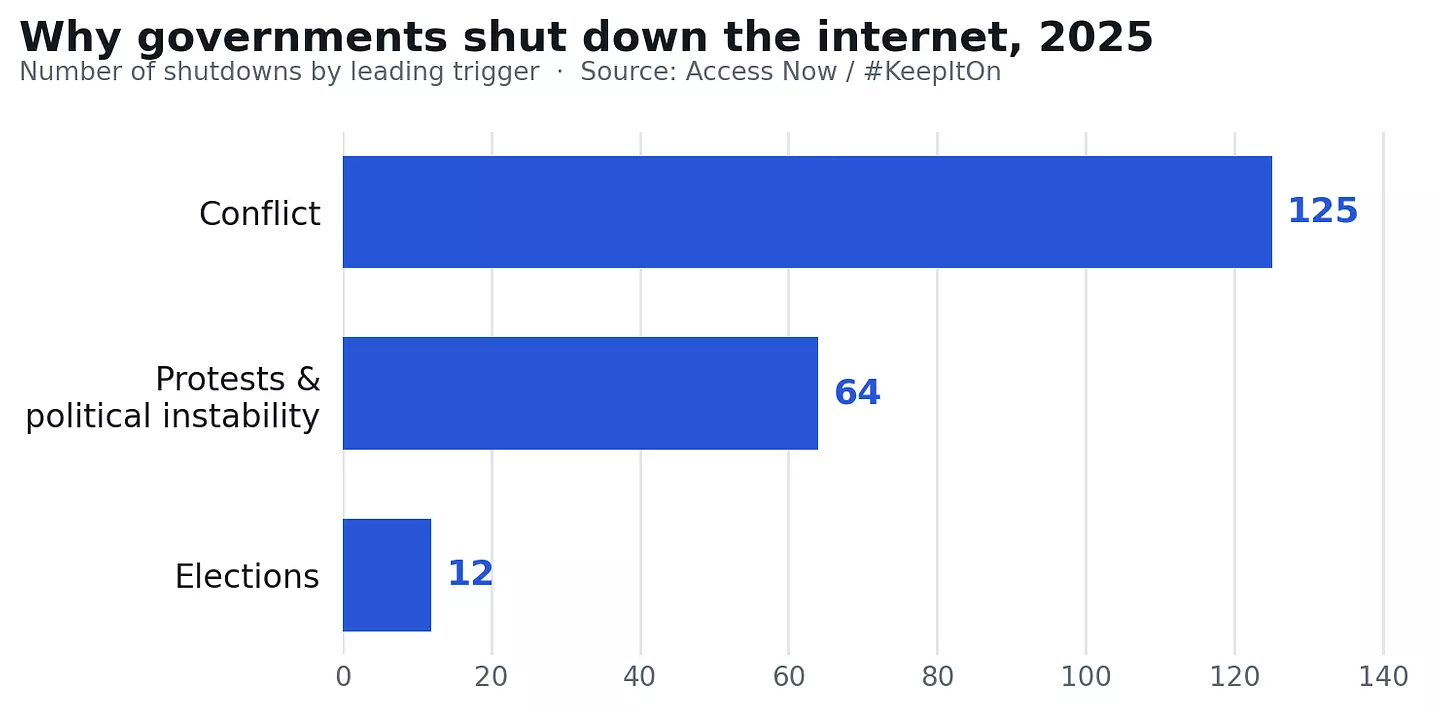
For the third year running, armed conflict was the leading trigger: 125 shutdowns across 14 countries, often used to hide atrocities. Protests came second (64 across 19 countries), then elections (12 across 8 countries). National exams remain a recurring reason in the Middle East and North Africa.
From whole networks to single apps
Short of a full blackout, the most common tactic is blocking specific platforms. By number of separate blocks in 2025:
Facebook: blocked 31 times across 18 countries
WhatsApp: blocked 27 times across 13 countries
Telegram: blocked 23 times across 16 countries
Instagram: blocked 20 times across 11 countries
Measured by hours offline, X (Twitter) was hit hardest with 18,354 hours blocked. A newer front is satellite internet: services like Starlink were jammed or banned 14 times across 7 countries in 2025, up from just 4 the year before.
What shutdowns cost the world
Top10VPN estimates that deliberate shutdowns cost the global economy $19.7 billion in 2025, a 156% jump on 2024 and the highest total since 2022. The damage was concentrated: Russia alone accounted for $11.9 billion, ahead of Venezuela ($1.91 billion) and Myanmar ($1.89 billion). Across the year, 120,095 hours of disruption were recorded, a 70% rise on 2024.
What shutdowns look like in VPN install data
Every figure above comes from an external tracker. These are ours: daily installs of the Browsec Chrome extension, by country, against the 30 days before each event. Trackers count shutdowns and economists price them. Install data shows what people do once one starts, and it shows that a platform block and a full blackout leave opposite marks.
When the network keeps working and only certain services are cut, installs jump the same day and fall back within a week. When the whole network goes down, installs cannot rise at all: a VPN has to be downloaded. Across Bangladesh's four-day shutdown in July 2024, installs there ran at 0.7% of their normal level, and three of those days record exactly zero. Through Iran's thirteen-day blackout in January 2026 they ran at 3.3%. In both cases the spike lands two to four days after reconnection, not during the shutdown.
Demand tracks access closely in both directions. Nepal withdrew its ban on 8 September 2025, and installs were back at their pre-ban level the next day.
Country | Event | Date | Restriction | Peak vs baseline |
|---|---|---|---|---|
Nepal | 26 platforms blocked | 4 Sep 2025 | Platform block | 31.4x |
Sri Lanka | Social media blocked during protests | 2 Apr 2022 | Platform block | 30.2x |
Bangladesh | Nationwide shutdown during protests | 19–22 Jul 2024 | Full blackout | 21.0x |
Belarus | Presidential election | 25 Jan 2025 | Platform block | 10.1x |
Iran | Nationwide shutdown, 13 days | 9–21 Jan 2026 | Full blackout | 7.7x |
Türkiye | Throttling after the Ankara attack | 23 Oct 2024 | Platform block | 7.1x |
Türkiye | Throttling after a mayor's arrest | 19 Mar 2025 | Platform block | 4.1x |
Peak daily installs of the Browsec Chrome extension as a multiple of the 30-day pre-event average. For blackouts the peak is the highest day in the three weeks after reconnection. Source: Browsec.
Worth stating plainly, because it cuts against our own interest: a VPN is no answer to a full blackout. It helps only while the network stays up and specific services are filtered. For Türkiye in March 2025 Top10VPN recorded a 188% rise in VPN searches; installs rose 306%. Searching is intent, installing is action, and here intent understated the response by about half.
How we measured this
Chrome Web Store install counts for the Browsec extension, daily by country, Sep 2021 – Sep 2026. An aggregated install counter only: no browsing, traffic or destination data is used or published, and figures are index values, not absolute installs. Baseline is mean daily installs over the 30 days before the event, the same definition Top10VPN uses for search demand. For blackouts the baseline is taken before the shutdown began, since installs are impossible while the network is down. An event is listed only where its peak exceeds the baseline by more than three standard deviations of daily installs in that country, and where the country averages at least 25 daily installs. Chrome Web Store dates are US Pacific, which can shift an Asian event by up to a day. Event windows come from Access Now, NetBlocks and OONI. Chrome extension only, so mobile-first countries are under-represented. Russia is excluded: our own domains are blocked there, so installs track availability rather than demand.
Spotlight: Russia became the costliest shutdown regime in the world
Russia's disruptions in 2025 were unlike the short, event-driven outages seen elsewhere: sustained, systemic and nationwide, mixing blackouts, throttling and protocol interference. One tactic, the so-called 16 KB Curtain, let only the first 16 kilobytes of Western sites load, leaving most services effectively unusable. For the wider picture of Russian blocking and the VPN crackdown, see our Internet Censorship Statistics page.
Methodology
Two main sources sit behind this page and measure different things. Access Now's #KeepItOn coalition counts discrete shutdown events through its STOP tracker: 313 events across 52 countries in 2025. Top10VPN estimates the economic cost of major outages using the NetBlocks COST tool and counts a smaller number of major outages (212 across 28 countries). Because their definitions differ, their totals are not directly comparable, so we use Access Now for counts and Top10VPN for cost, and label each figure accordingly. All figures cover calendar year 2025 unless stated; past-year numbers are periodically revised as new cases are verified.
Sources
Browsec, Chrome Web Store install data analysis for this page
Access Now / #KeepItOn, Internet Shutdowns in 2025 (published 31 Mar 2026)
이 글 인용하기
Browsec. "Internet Shutdown Statistics 2026." Browsec Blog, 2026년 08월 06일, https://browsec.com/ko/blog/internet-shutdown-statistics.