Internet Censorship Statistics 2026
목차
A data-backed look at how internet censorship is spreading worldwide: how many people are affected, which countries are the most and least restrictive, and how online freedom has changed over time. Every figure is sourced and dated.
Key Figures
Internet freedom keeps declining for 15 years straight
Online freedom has fallen for the 15th year in a row. Of the 72 countries assessed in Freedom on the Net 2025, conditions worsened in 28 and improved in only 17. The slide is not limited to authoritarian states: half of the 18 countries rated “Free” saw their scores drop during the coverage period.
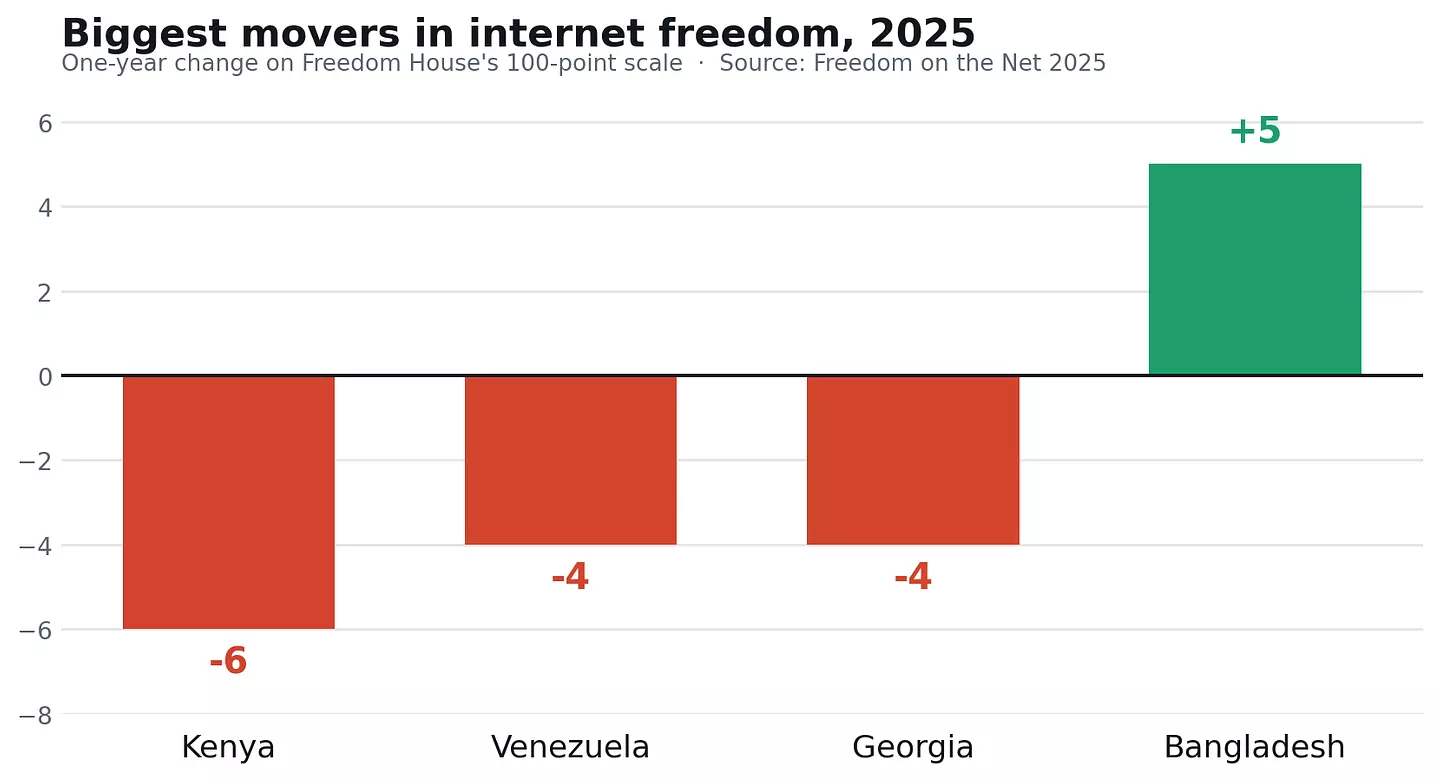
One-year score change on Freedom House’s 100-point scale. Source: Freedom on the Net 2025.
Internet shutdowns are tracked separately - see our Internet Shutdown Statistics page.
How many people live without a free internet?
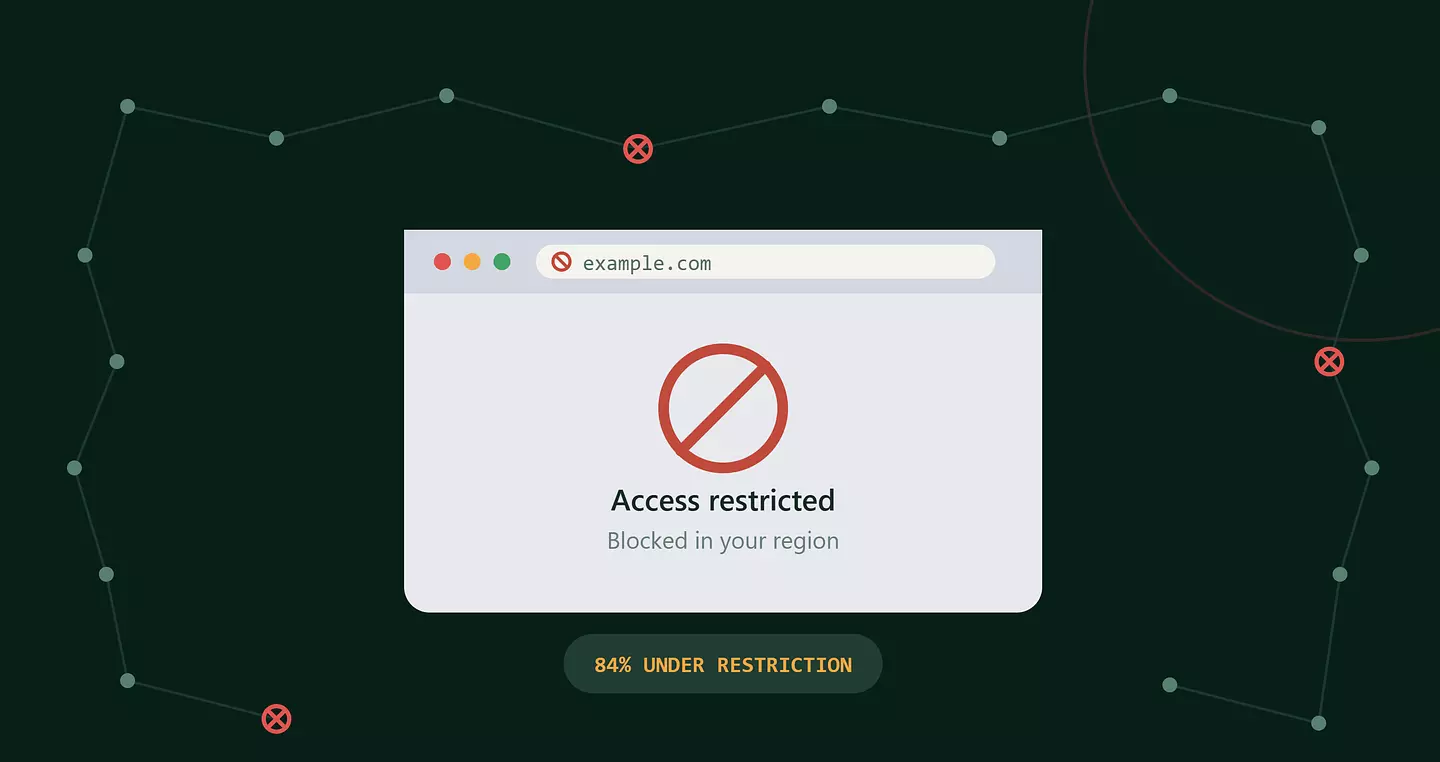
About 5 billion. Freedom House finds that only ~16% of the world’s internet users live in a “Free” online environment, leaving ~84%. Applied to the ITU’s estimate of ~6 billion internet users in 2025, that works out to roughly 5 billion people. The full derivation is in the Methodology below.
Internet censorship by country
Country | 2025 change & note | Status |
|---|---|---|
China | Worst environment (tied) | Not Free |
Myanmar | Worst environment (tied) | Not Free |
Iceland | Freest environment | Free |
Kenya | −6 largest one-year decline | — |
Venezuela | −4 steep decline | Not Free |
Georgia | −4 steep decline | — |
Bangladesh | +5 largest one-year gain | — |
Russia | Among the steepest 15-year declines | Not Free |
Source: Freedom House, Freedom on the Net 2025.
Egypt, Pakistan, Russia, Turkey and Venezuela have seen the most extreme declines over the past 15 years.
Internet censorship by region
Europe holds the strongest scores in the index almost across the board, led by Iceland, Estonia, and the Nordic and Baltic states.
Asia shows the widest split: stable democracies like Japan and South Korea score high, while China, Myanmar, and Vietnam anchor the bottom.
Eurasia has no Free-rated countries at all, Russia, Belarus, and Turkey are all rated Not Free, and Turkey's score has fallen over 20 points since 2011.
Region | Country | 2025 score | Status |
|---|---|---|---|
Europe | Iceland | 94 | Free |
Europe | Estonia | 91 | Free |
Americas | Chile | 87 | Free |
Asia | Japan | 78 | Free |
Asia | South Korea | 65 | Partly Free |
Eurasia | Turkey | 31 | Not Free |
Eurasia | Belarus | 20 | Not Free |
Eurasia | Russia | 17 | Not Free |
Asia | China | 9 | Not Free |
Source: Freedom House, Freedom on the Net 2025.
Age verification and access rules
Not every restriction is a block. Since 2025 a number of countries have introduced rules requiring sites to check a visitor's age. The United Kingdom's age-assurance duties under the Online Safety Act took effect on 25 July 2025, enforced by Ofcom. France's rules are enforced by Arcom, Italy's by AGCOM from late 2025, and Australia's minimum-age rules for social media by the eSafety Commissioner from December 2025. Several US states run their own timetables. Freedom on the Net assesses rules of this kind alongside everything else it measures, which is part of why scores moved in several countries rated Free.
They work differently from the blocking described above. They are announced ahead of time, they take effect on a set date, and the service itself keeps running. What changes is what a visitor is asked for, though not always: in France on 4 June 2025 the operator of several large adult sites suspended access for French users in protest at the rules rather than implement checks.
They also register differently in the data. On Top10VPN's measure, VPN searches in the UK rose 1,987% in the three days after the Online Safety Act's checks took effect. Installs of our own browser extension in the UK rose 94% over the same window: a clear response, and a much smaller one. Around the French suspension in June 2025 and in Australia in March 2026, searches rose 570% and 330% on the same measure while our installs stayed within ordinary daily variation.
We take no position here on the rules themselves. The observation is narrower, and it is about measurement: interest and installation respond on very different scales, and a figure drawn from search volume alone overstates how much actually changed. The full comparison is in our VPN usage statistics.
Spotlight: Russia
Internet freedom in Russia hit a new low in 2025, as authorities intensified efforts to isolate the population from the global internet. Roskomnadzor expanded the blocking and throttling of platforms carrying user-generated content and independent news, moved to block end-to-end encrypted messaging apps, and began throttling internet access nationwide in May 2025, officially citing the threat of drone strikes. Russia's Freedom on the Net score has kept falling as a result: 21 out of 100 in the 2023 report, down to 17 in 2025, placing it among the two or three lowest-scoring countries in the world.
The response is visible in our own numbers: installs of the Browsec browser extension in Russia roughly doubled in the third quarter of 2024, the quarter VPN apps were being removed from the Russian App Store, and have stayed at that level since. What that says about measuring VPN use is in our VPN usage statistics.
Source: Freedom House, Russia: Freedom on the Net 2025 Country Report.
How we get the ~5 billion figure
Freedom House (Freedom on the Net 2025) reports that 16% of the world’s internet users live in countries rated Free, implying 84% do not. Applied to the ITU’s 2025 estimate of ~6 billion internet users:
0.84 × 6B ≈ 5.040B → rounded to “~5 billion”
We round because both inputs are themselves estimates. Caveats: Freedom on the Net assesses 72 countries (~89% of internet users), so the remaining ~11% are outside the sample. The FOTN 2025 coverage period is June 2024 - May 2025; ITU data is for 2025.
Sources
Browsec, Chrome Web Store install data for the Browsec extension, daily by country, Sep 2021 – Sep 2026 (original analysis)
Ofcom, Age checks to protect children online (United Kingdom), age assurance duties in force 25 Jul 2025
Arcom, Protection des mineurs contre la pornographie en ligne (France)
AGCOM, La tutela dei minori mediante i sistemi di age verification (Italy), Resolution 96/25/CONS, obligations in force 12 Nov 2025
eSafety Commissioner, Social media age restrictions (Australia), in force 10 Dec 2025
Freedom House, Freedom on the Net 2025: An Uncertain Future for the Global Internet, Published 13 Nov 2025
ITU, Facts and Figures 2025, Published 17 Nov 2025
이 글 인용하기
Browsec. "Internet Censorship Statistics 2026." Browsec Blog, 2026년 08월 06일, https://browsec.com/ko/blog/internet-censorship-statistics.